
Researchers in Cambridge have identified a new immune pathway that could lead to less toxic treatments for some childhood brain cancers.
The study, published in Nature Genetics, provides new insight into how childhood brain tumours interact with the immune system. Using the cerebrospinal fluid, these tumours can send signals to immune cells in the brain’s border tissues and skull bone marrow. This teaches those immune cells to tolerate the tumour instead of attacking it.
The research team demonstrated that blocking these tumour-derived signals can re-engage the immune system to recognise and attack cancer cells. The findings identify a potential new treatment approach, which appears to have very few side effects.
Dr Elizabeth Cooper, the study’s first author, is one of our Expanding Theories awardees. Cancer Research UK and the Little Princess Trust also supported this research.
Treating childhood brain cancer
In this study, researchers looked at three models of childhood brain cancer: ependymoma, choroid plexus carcinoma and medulloblastoma. Each of them can be aggressive.
Current treatment options, including surgery, radiotherapy and chemotherapy, can have long term side effects that significantly impact quality of life. For example, some children develop epilepsy after treatment for a brain tumour. Radiotherapy and chemotherapy can also affect things like growth, puberty and fertility. Find out more about the long-term impact of a childhood brain tumour
Researchers are exploring alternative treatments for childhood brain cancers. Immunotherapy holds promise as it tends to cause fewer side effects than traditional cancer treatments.
But immunotherapy has so far had little success against brain cancers. Major obstacles include the complexity of these tumours, as well as difficulties crossing the blood-brain barrier to reach them.
What did the study find?
Almost all childhood brain tumours begin developing before birth, before the immune system has fully developed. Scientists believe it is possible the body comes to see the tumour as part of itself and allows it to grow unchecked.
The research team set out to understand more about the role of surrounding cells in the skull and other tissues. Using preclinical models, they discovered a previously unknown immune communication pathway that exists outside the tumour.
They observed that signals from the tumour travel through the cerebrospinal fluid to reach the brain’s border tissues and skull bone marrow. There, they reprogramme immune cells, educating them not to attack. This enables the tumour to keep growing.
A new therapeutic strategy for childhood brain cancer
Significantly, researchers were able to block the tumour-derived signals using antibody treatments in their three models. The treatments prompted the immune system to recognise and attack the tumours, causing them to shrink and improving survival.
Showing this pathway can be therapeutically targeted represents a new way of thinking about immune evasion in childhood brain cancer. This knowledge could help find ways to use immune therapies for brain tumours more effectively.
“What surprised me most was just how much the tumour communicates with the immune system outside of the tumour itself. For a long time, we’ve focused on what’s happening inside the tumour, but we’ve been missing how tumours can ‘train’ immune cells in nearby brain tissues to tolerate them. The exciting part is that this gives us new opportunities to intervene, potentially allowing immunotherapies to work for children with brain tumours in ways they haven’t before.”
Dr Elizabeth Cooper, Cancer Research UK Cambridge Institute
What’s next?
Further work is now needed to test whether this approach is safe and effective for children.
If the team’s findings in the laboratory can be replicated in clinical trials, it could lead to the development of gentler, immune-based treatments for children with childhood brain cancers. Researchers hope the approach could help improve survival, while preserving quality of life.
Find out more about Dr Elizabeth Cooper’s research
Dr Elizabeth Cooper
As a neuroimmunologist, Dr Cooper studies intricate interactions between the immune system and central nervous system. Her focus is on their roles in normal brain development and the formation of childhood brain tumours.
Last year, we awarded Dr Cooper an Expanding Theories grant of £150,000 over two years. Through this funding scheme, we are proud to support pilot studies exploring innovative ideas.

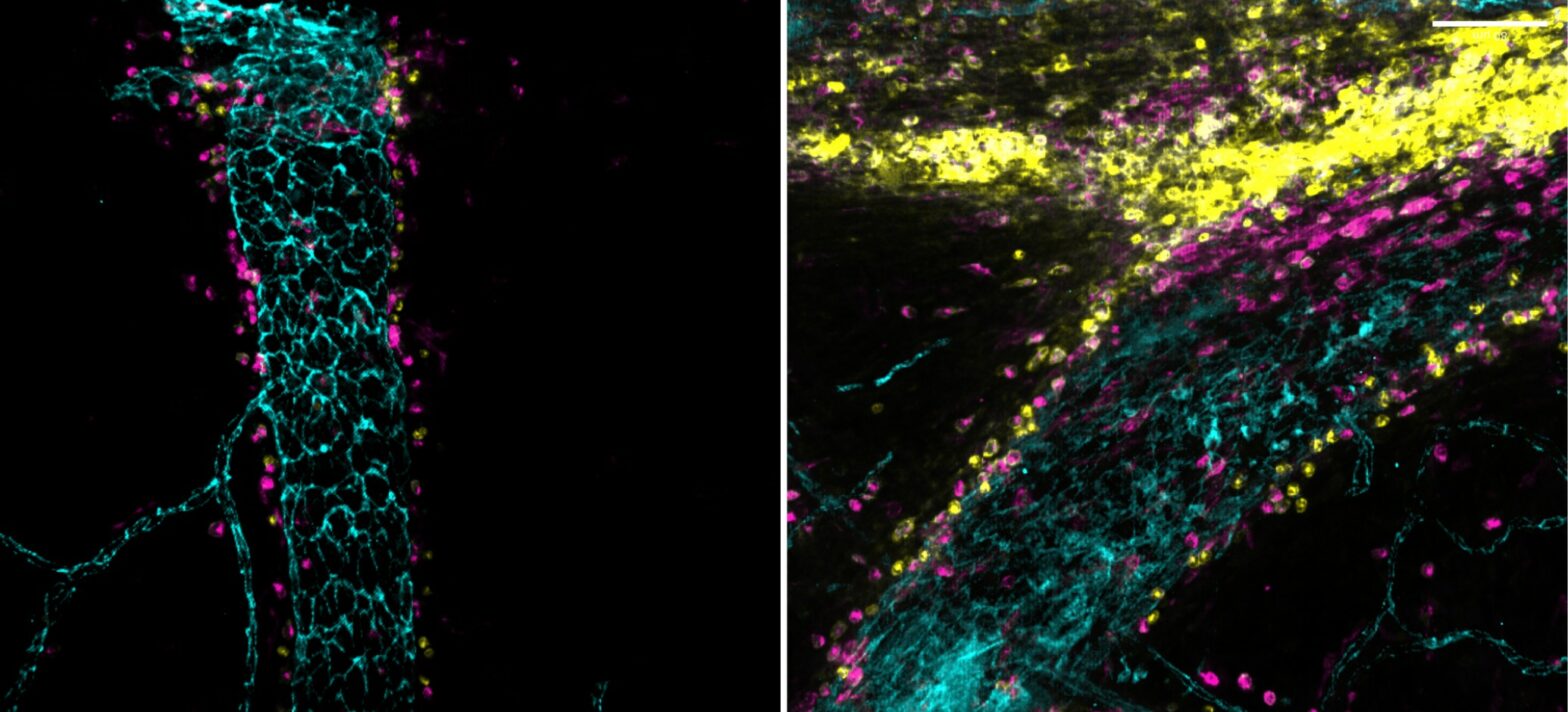
Featured image courtesy of Dr Elizabeth Cooper. Captured using fluorescent microscopy, it shows a bridging vein from non-tumour tissue on the left and a bridging vein from tumour tissue – with substantially more T cell (yellow) clusters – on the right.