
Day One
The distress of delayed diagnosis
Our survey results show that the brain tumour community experiences great psychological distress and anxiety waiting for test results to confirm their brain tumour diagnosis.
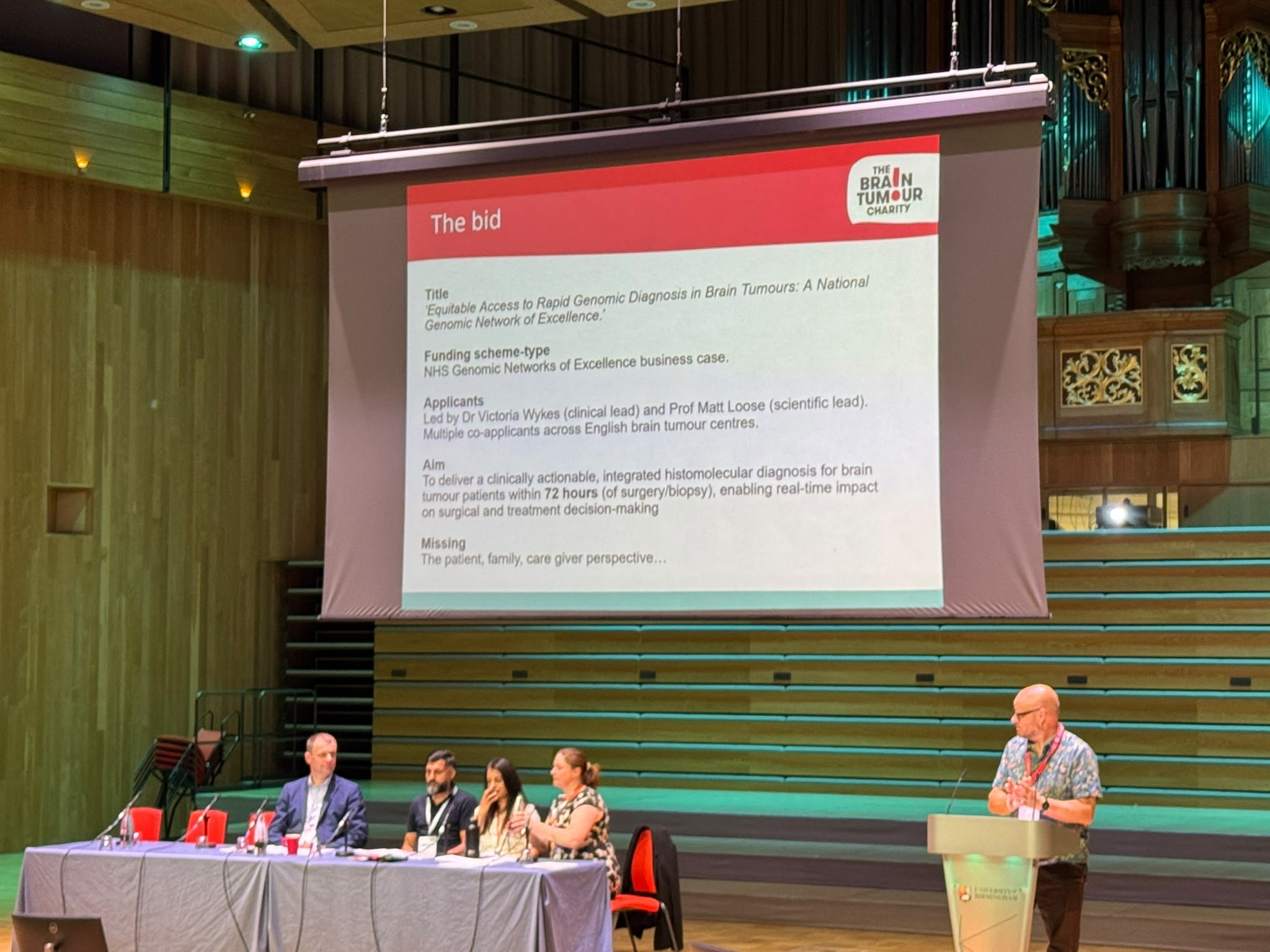
We shared these results on the first day of the BNOS conference at the University of Birmingham, and discussed the potential for new technologies to deliver faster tests results and ease those issues.
The theme of this year’s conference celebrates the progress being made “at the crossroads of neuro-oncology, biology, and technology, advances that are transforming treatment approaches and offering new hope for patients.”
The patient voice
A patient explained that when she was given the choice of ‘watch and wait’ or a brain tumour biopsy, she chose the biopsy. But it took almost six weeks to get the results.
That six weeks felt longer because of a fear of the unknown. She asked herself: “What do I need to plan? What do I need to put in place?”
A qualitative study in Nottingham also investigated the psychological effects of waiting for test results.
Jay Kotecha, a neurosurgery registrar, said their study involved interviews with seven adults and three sets of parents of paediatric patients and identified similar themes.
Our survey results
- Responses from 134 adults across England highlighted widespread delays and variations in access to advanced molecular testing.
- 26% of respondents waited more than a month for full diagnostic test results. Nearly half (48.1%) felt this was too long.
- Only 33% reported that their tissue was sent for further genetic analysis, while another third was not offered this and a similar proportion were unsure.
- 92.4% of respondents felt that receiving accurate results within three days would reduce anxiety, enable earlier treatment, and provide the clarity needed to choose from treatment options – where applicable.
Jay’s colleague at the University of Nottingham, Professor Matthew Loose, said nanopore sequencing is one of the new technologies being developed. It means brain tumour classification is now possible within two hours, with final molecular data available the next day.
Professor Tom Jacques at Great Ormond Steet Hospital, who’s on the expert editorial board of the WHO Classification of Tumours, said he was keen to implement these new technologies into children’s brain tumour care too.
The future: A network of excellence
The aim now is to help implement these technologies and standardise the collection of fresh frozen tissue.
Creating a Network of Excellence could help ensure rapid diagnostics become standard practice – improving experiences and outcomes for people affected by brain tumours across the UK.
“This is something we can solve. We have the technology now.”
Dr Simon Newman, Chief Scientific Officer, The Brain Tumour Charity
Other talks on the first day of BNOS included the launch of the clinical trials board ACT-BT by Professor Susan Short; an abstract about our free counselling service – which has delivered 14,000 sessions since it launched in July 2022 – by Joanna Moss; a keynote speech by Professor Nader Sanai on drug developments in glioma; and talks by Dr Ola Rominiyi on the EPIC-GB clinical trial he’s leading; and by Professor Colin Watts on Brain MATRIX.