
Day One
The distress – and solution for – delayed diagnosis
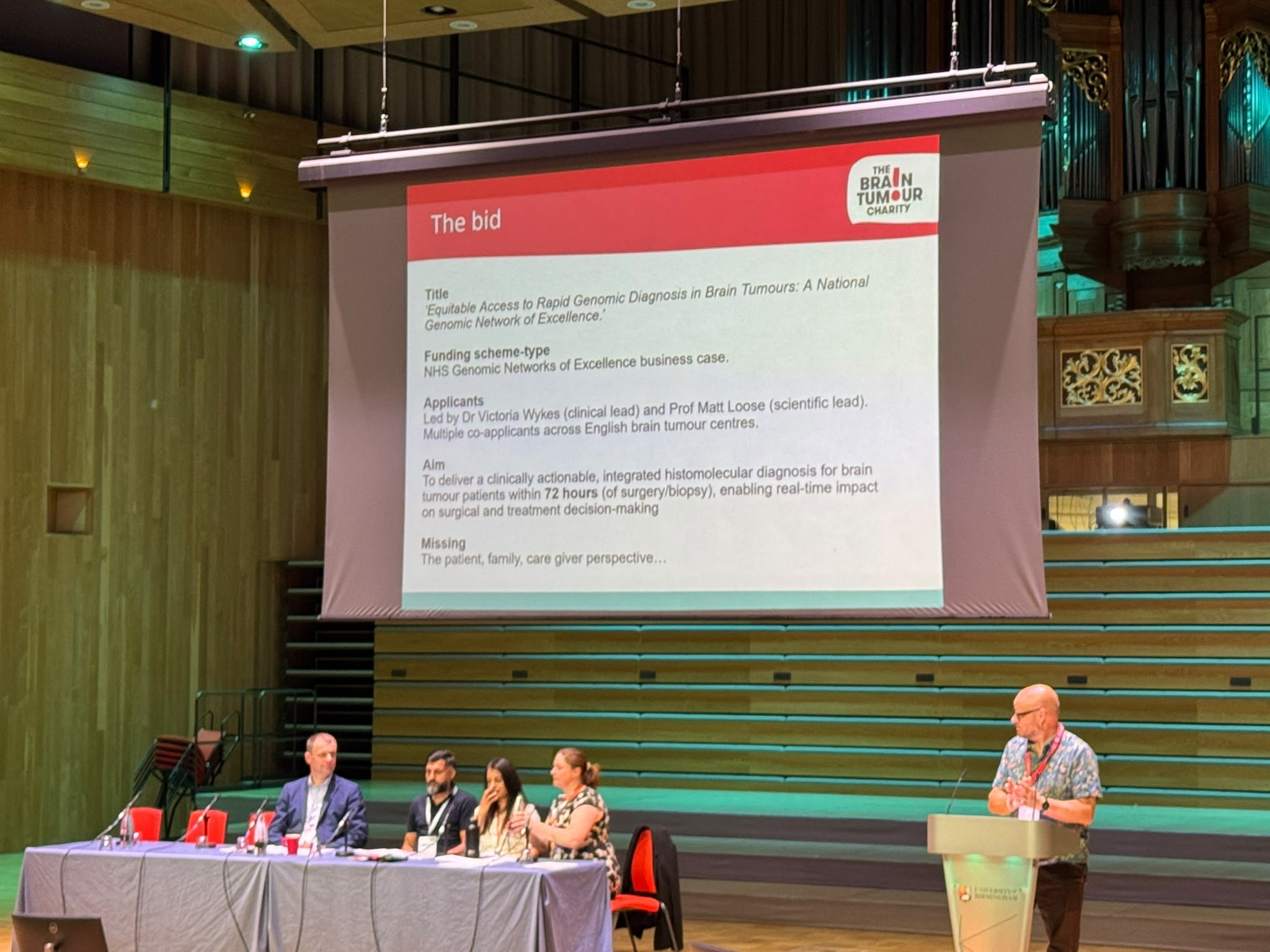
Our survey results show that the brain tumour community experiences great psychological distress and anxiety waiting for test results to confirm their brain tumour diagnosis.
We shared these results on the first day of the BNOS conference at the University of Birmingham, and discussed the potential for new technologies to deliver faster tests results and ease those issues.
The theme of this year’s conference celebrates the progress being made “at the crossroads of neuro-oncology, biology, and technology, advances that are transforming treatment approaches and offering new hope for patients.”
“This is something we can solve. We have the technology now.”
Dr Simon Newman, Chief Scientific Officer, The Brain Tumour Charity
The patient voice
A patient explained that when she was given the choice of ‘watch and wait’ or a brain tumour biopsy, she chose the biopsy. But it took almost six weeks to get the results.
That six weeks felt longer because of a fear of the unknown. She asked herself: “What do I need to plan? What do I need to put in place?”
A qualitative study in Nottingham also investigated the psychological effects of waiting for test results.
Jay Kotecha, a neurosurgery registrar, said their study involved interviews with seven adults and three sets of parents of paediatric patients and identified similar themes.
Our survey results
- Responses from 134 adults across England highlighted widespread delays and variations in access to advanced molecular testing.
- 26% of respondents waited more than a month for full diagnostic test results. Nearly half (48.1%) felt this was too long.
- Only 33% reported that their tissue was sent for further genetic analysis, while another third was not offered this and a similar proportion were unsure.
- 92.4% of respondents felt that receiving accurate results within three days would reduce anxiety, enable earlier treatment, and provide the clarity needed to choose from treatment options – where applicable.
Jay’s colleague at the University of Nottingham, Professor Matthew Loose, said nanopore sequencing is one of the new technologies being developed. It means brain tumour classification is now possible within two hours, with final molecular data available the next day.
Professor Tom Jacques at Great Ormond Steet Hospital, who’s on the expert editorial board of the WHO Classification of Tumours, said he was keen to implement these new technologies into children’s brain tumour care too.
The future: A network of excellence
The aim now is to help implement these technologies and standardise the collection of fresh frozen tissue.
Creating a Network of Excellence could help ensure rapid diagnostics become standard practice – improving experiences and outcomes for people affected by brain tumours across the UK.
Other talks on the first day of BNOS included the launch of the clinical trials board ACT-BT by Professor Susan Short; an abstract about our free counselling service – which has delivered 14,000 sessions since it launched in July 2022 – by Joanna Moss; a keynote speech by Professor Nader Sanai on drug developments in glioma; and talks by Dr Ola Rominiyi on the EPIC-GB clinical trial he’s leading; and by Professor Colin Watts on Brain MATRIX.
Day Two
Vorasidenib: clinical trial to NHS access
A key focus on day two was vorasidenib, a new oral treatment for IDH-mutant low-grade gliomas.
Professor Catherine McBain, from The Christie Hospital in Manchester, presented new data from the phase 3 INDIGO trial of vorasidenib versus placebo. This was first outlined at the American Society of Clinical Oncology conference three weeks earlier.
Key findings included:
- 58% of patients remained on vorasidenib.
- 48% of patients remained progression-free nearly four years later.
- patients initially assigned the placebo were later offered vorasidenib.
- Vorasidenib reduced seizure frequency
- Seizure reduction continued the longer people remained on the medication, sustaining quality of life.
Response increases and deepens the longer people are on the drug. It’s very well tolerated with few side effects in terms of fatigue, nausea or anything else.
Prof McBain
From surviving to thriving
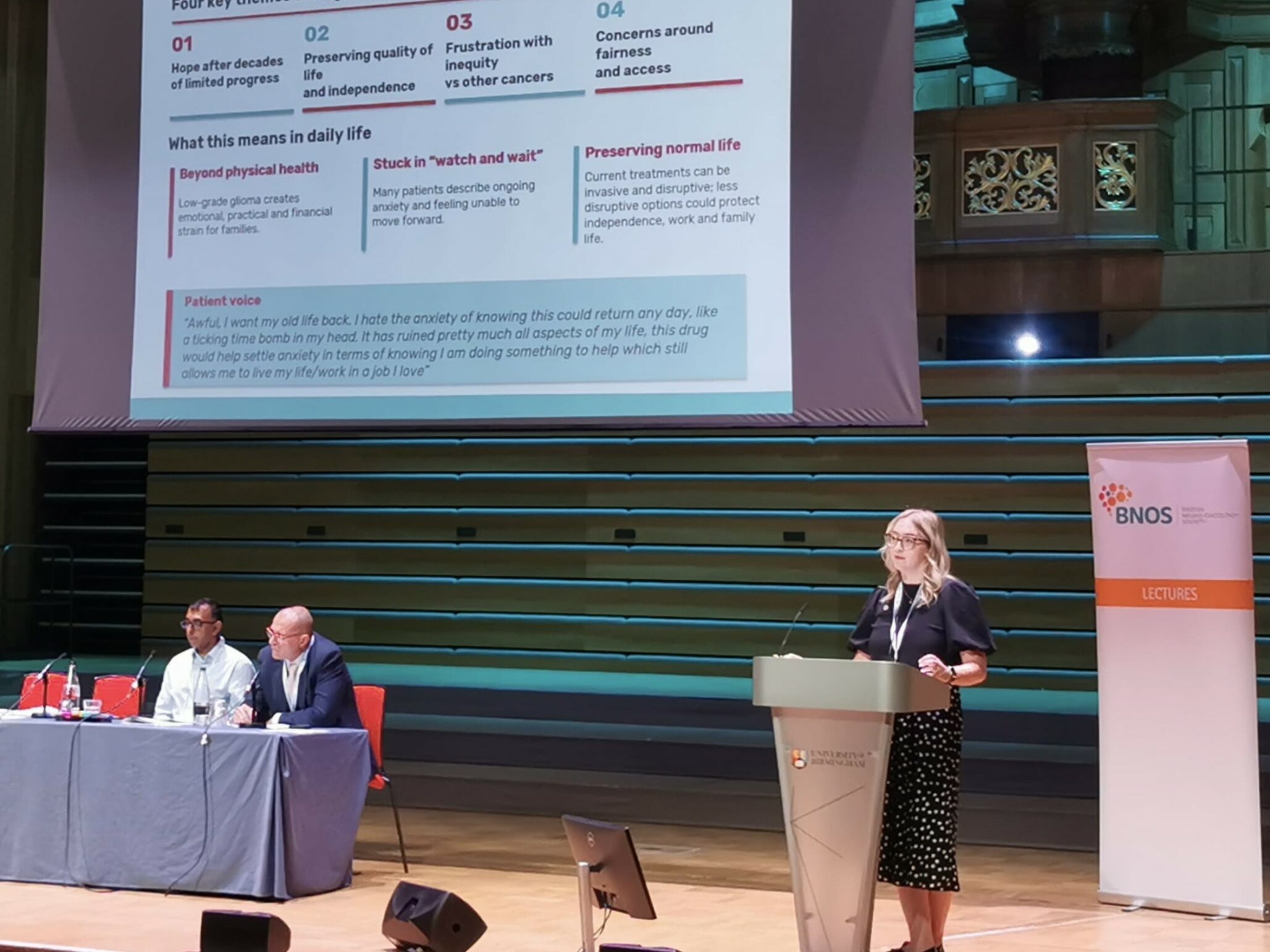
Our Head of Support, Shannon Winslade, explained how patient voice was central. Our survey results along with qualitative evidence helped inform NICE, contributing to its decision to make the treatment available on the NHS.
Shannon said patients spoke about the treatment meant they were not just surviving but thriving – returning to work and maintaining daily routines. The ability to take the treatment at home was also a clear benefit.
Reflecting on the moment the moment the medication was recommended for use on the NHS, Shannon said: “It felt like a clear recognition of the importance of quality of life to the brain tumour community, as well as the day-to-day impact.”
Making new treatments available
Abraham Sondhi from the University of Leeds spoke about the real-world use of vorasidenib in eligible patients and highlighted the barriers that are affecting access. (Hospital trusts have 90 days to make new treatments available when they’re approved for use on the NHS.)
These barriers include awaiting NICE guidance, workforce capacity in clinics, the need to follow funding processes and broad eligibility criteria.
He concluded: “Vorasidenib offers an important therapeutic option in low grade glioma, but wider implementation will require significant service investment.”
Dr Brooke Smart from the Royal Marsden Hospital shared her practical experience of prescribing vorasidenib and stressed the importance of close monitoring, particularly for potential effects on liver function – an indication of toxicity.
Vorasidenib can be delivered safely and efficiently through an oral SACT service, improving patient experience while preserving specialist clinic capacity.”
Dr Brooke Smart
(SACT stands for Systemic Anti-Cancer Therapy and includes the processes and support needed to ensure patient safety when taking cancer treatments at home rather than in hospital.)
Other key speeches today included an overview of the National Cancer Plan, a presentation on a pilot project working with GPs to increase their confidence in referring patients for scans in case of suspected brain tumours, and a talk by Cameron Miller on national strategies.
Day Three
The cost of a brain tumour diagnosis
Our Head of Policy and Campaigns, Marcus Cahill-Evans outlined the results of our report examining the economic burden brain tumour diagnoses bear on both the individual and the UK economy.
York Health Economic Consortium calculated that in 2025, newly-diagnosed brain tumours created an estimated £18.7bn economic burden for the UK over those people’s lifetime – that’s £1.47m per person on average.
That figure includes:
- £5.17bn from things like lost earnings, welfare payments, care costs and direct healthcare spend.
- £13.5bn in the value of healthy years lost, based on the government’s own QALY valuation of years of life lived in good health.
The calculation was based on data showing that in 2025 there were 5,629 high-grade and 6,528 low-grade tumours diagnosed in adults, and 316 high-grade and 287 low-grade tumours diagnosed in children.
High-grade tumours accounted for 86 percent of the overall burden. The burden of illness per tumour was £1.3 million for adults and £4.4 million for children. Premature mortality was the largest contributor to the overall burden with this reflected in terms of both lost health and lost future income.
Marcus concluded: “The burden of brain tumours in the UK is considerable and is largely driven by premature mortality and the associated loss of health and income. Interventions that extend life have the greatest potential to reduce that burden, including programmes to increase early diagnosis, and new innovative treatments.”
The report reiterates our call for a National Brain Tumour Strategy.
And that’s a wrap on just some of the highlights of BNOS 2026, with special thanks to Hannah Clargo-Jones for reporting back to Charity HQ from Birmingham. Next year’s conference is at G-Live in Guildford.