Glioblastoma prognosis
Glioblastoma prognosis is when your doctor or medical team explains what you might expect from your diagnosis. Here we discuss average glioblastoma prognosis, but your prognosis will depend on things specific to you, such as how well you respond to treatment.
Short summary
Glioblastoma is an aggressive type of brain tumour. And, the survival time for glioblastoma is sadly short on average. We give averages on this page, but please remember that everyone is different and averages can’t say what will happen to you specifically.
We know that glioblastoma prognosis is a sensitive topic and can be difficult to read about. Our Support Team is here if this is worrying or upsetting for you.
On this page:
- About glioblastomas
- What is a glioblastoma prognosis?
- Glioblastoma survival rate
- What can affect glioblastoma prognosis
- Approaching glioblastoma prognosis
Get support
If you would like more information or just a listening ear, the members of our kind and approachable Support Team are here for you.
Get your free Information Pack
Our Brain Tumour Information Pack can help you better understand your diagnosis and feel confident talking to your medical team.
Free counselling service
If you would like to talk to someone, we offer up to eight free counselling sessions to anyone diagnosed with a brain tumour or their loved ones.
About glioblastoma brain tumours
Glioblastomas (or GBMs) are grade 4 brain tumours. This is the highest grade and means glioblastomas are seen as cancerous.
They are the most common high grade primary brain tumour in adults. Primary brain tumours are tumours that begin in the brain as opposed to spreading there.
Treatment for glioblastoma can include surgery followed by chemotherapy and radiotherapy.
What is a glioblastoma prognosis?
A prognosis is when your doctor tells you what to expect if you have a diagnosis, such as a glioblastoma.
Your doctor can’t be absolutely certain about what will happen to you following a brain tumour diagnosis. But, they can give you an estimate, based on your tumour type and current situation.
There are some things your doctor might not be able to predict, like how well you might respond to treatment. Cancer Research UK have some information about the things that can impact brain tumour survival.
This is why prognosis is often an ongoing process, revised at different stages in your journey.
Glioblastoma survival rate
Here are the current statistics we have on glioblastoma prognosis:
- Average survival time: 12-18 months
- Average survival rate: 25% of patients survive more than one year, and more than 5% of patients survive five years or more
The figures above are given in 1 and 5-year intervals just because doctors use these intervals for research and measuring. They aren’t meant to represent how long a person with a glioblastoma will live past those intervals. For example, a person who is a 5-year survivor might live as long as any other healthy person, depending on their circumstances.
Please remember that statistics and averages can’t tell you what will happen to you specifically.
What can affect glioblastoma prognosis?
Glioblastoma prognosis depends on a few things:
- Age: Younger people tend to respond better to treatment
- Gender: Some studies show that men are slightly more likely to be diagnosed with a glioblastoma than women
- Where the tumour grows: Some parts of the brain are safer to treat than others, so there might be more treatment options if the tumour isn’t close to anything vital
- General health: People who have better general health might respond better to treatment
- Biomarkers: There is a biomarker called MGMT methylation that some people have that might make chemotherapy destroy the tumour cells better
- The amount of tumour removal: If more of the tumour can be removed with treatment, it reduces the chances of the tumour growing back.
Receiving information about a glioblastoma prognosis
Different people approach their prognosis in different ways.
- Some do not want to know, because they are afraid of what they might hear and how it may affect them
- Some just need some time to cope with their diagnosis before asking about their prognosis
- Others may want to know from the beginning, using their prognosis to plan ahead
There is no right or wrong answer to how or when you receive the news. It’s entirely up to you when, or if, you want to speak to your doctor about your prognosis.
If you are feeling unsure or worried about a glioblastoma prognosis, contact our Support team on 0808 800 0004 or at [email protected].
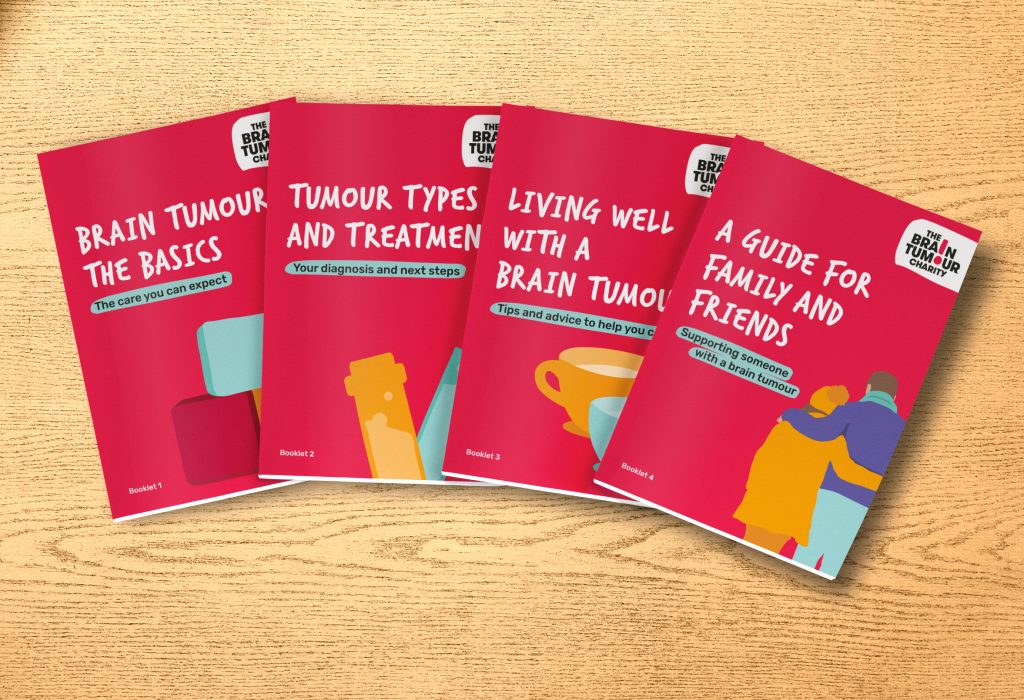
Get your free Information Pack
Our Brain Tumour Information Pack can help you better understand your diagnosis and feel confident talking to your medical team.
Support and Information Services
Research & Clinical Trials Information
You can also join our active online community.
In this section

Get support
If you need someone to talk to or advice on where to get help, our Support and Information team is available by phone, email or live-chat.